Project Morpheus: Natural Language Home Search
Overnight prototype, launched in weeks, lifted lead conversion 7×, Realtor.com's biggest release of the year.
2025 / Principal Engineer / conceived, prototyped and led production delivery
Conceived and prototyped an NER-based free text search system (Project Morpheus) overnight as an alternative to a failing AI initiative. After months of advocacy and setbacks, I rebuilt the full product from scratch in one week after returning from paternity leave, and delivered Realtor.com's most impactful launch of the year. Morpheus increased lead conversion 7× over legacy search, established a sustainable foundation for future AI products, and added negligible operating cost.
01Context & StakesRead moreHide
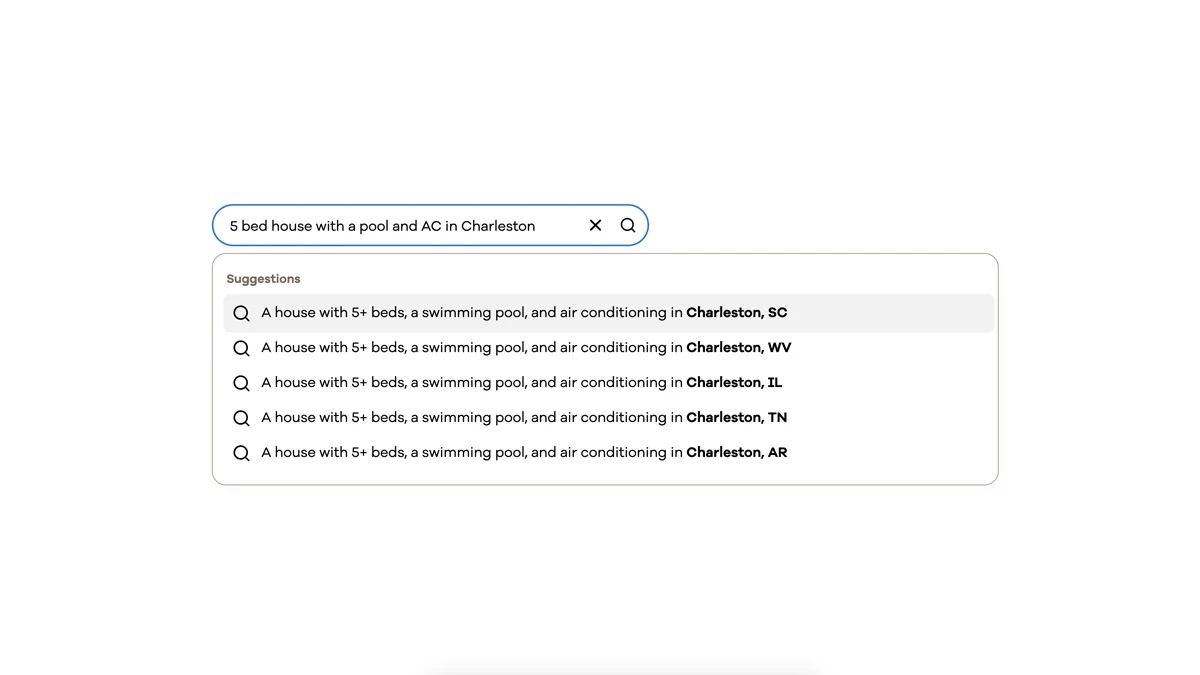
For years, Realtor.com had been exploring ways to use AI to create a differentiated search experience. The flagship effort was an "AI Search" initiative meant to help users find exactly what they wanted through more intelligent, contextual queries. At the time, search meant choosing a geographic area and then narrowing results with dropdown filters.
Despite nearly two years of investment, the project struggled to meet quality bars and never shipped a viable product. Marketing campaigns were paused, leadership confidence was fading, and competitors like Zillow and Homes.com were gaining momentum with their own AI features.
By Fall 2024, the initiative was on the verge of collapse. User tests returned CSAT scores below 3/10, and engineering velocity had stalled.
02Problem → InsightRead moreHide
The project's direction had drifted toward complexity. The team was investing heavily in custom ML pipelines and an LLM designed to scan listing photos for features a user might describe, like "a house with a white picket fence."
Stepping back to evaluate the problem (my team owned the front end experience), I saw that both the product strategy and the technical approach were misaligned with user expectations and system realities.
- Real usage data told a simpler story. Filter-interaction analysis showed our existing structured filters already covered ~98% of user intent. Generating image-based metadata on demand was over-engineering for negligible gain.
- Performance and cost were unsustainable. LLM inference added multi-second latency and high per-query cost, unacceptable where users expect sub-second results across tens of millions of requests a day.
- The UX was fractured. The prototype pulled users out of the normal search flow, adding friction and reducing engagement.
"The idea of just typing what you want was right, but the approach was wrong."
We didn't need a new AI-heavy search engine. We needed a lightweight natural language layer that mapped free form text to our existing, high performance filter system. The winning solution had to feel instant, scale efficiently, and run at near-zero incremental cost.
03The Overnight PrototypeRead moreHide
That same night, I built the first working concept of the path I believed was right: a lightweight JavaScript parser paired with a React demo front end.
The parser used a Named Entity Recognition (NER) approach, combining regex and JavaScript logic to extract intent from user queries. A small subset of filters needed special handling for min/max ranges and numeric bounds, but the vast majority of our ~300 filters were boolean. That made it feasible to capture common phrases and synonyms and translate them directly into our filter schema. It could parse a query like "three bedroom with hardwood floors under 600k" and map it to structured filters in milliseconds.
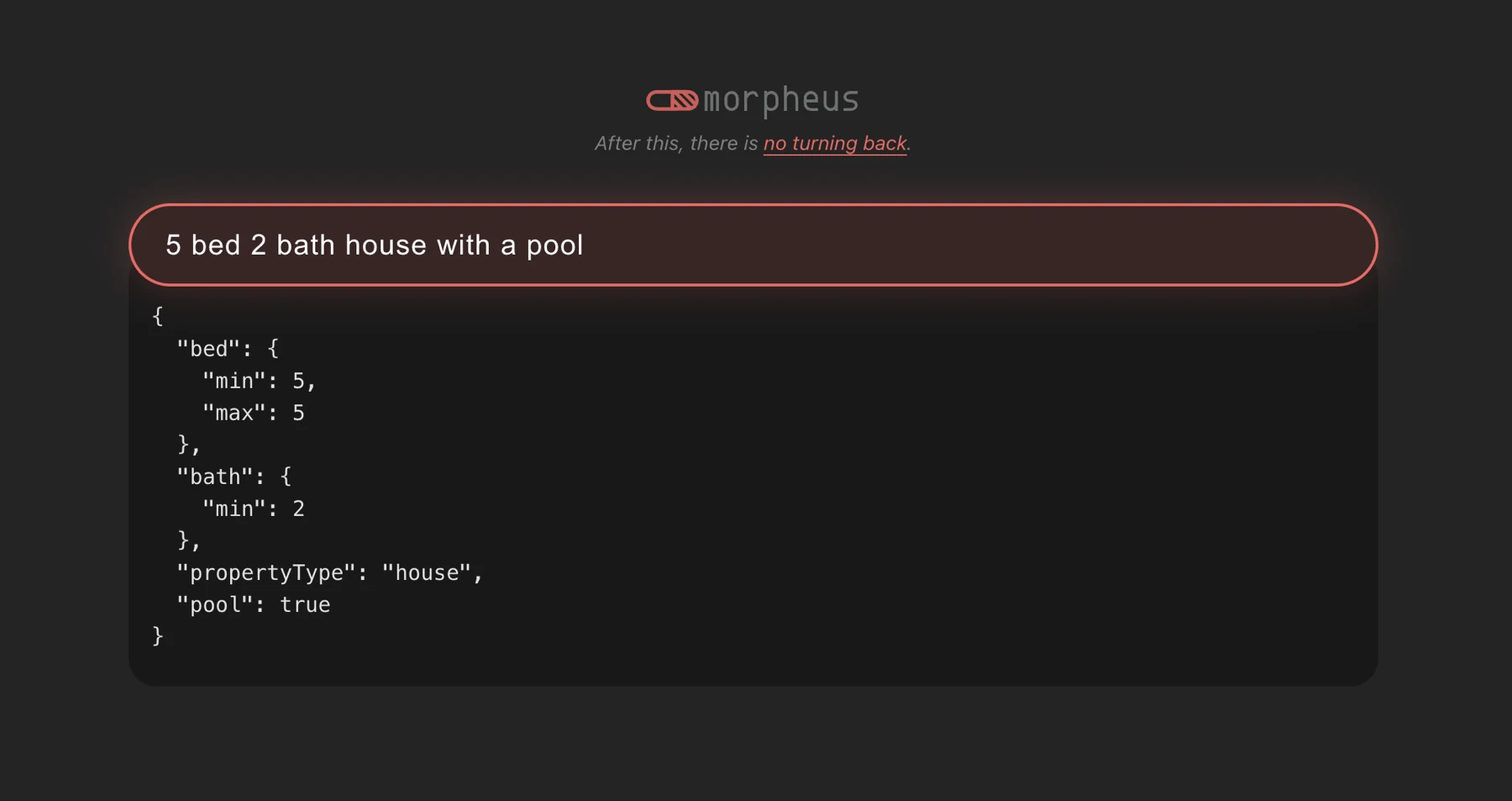
The next morning I demoed the prototype to our PM. He immediately saw the potential, and we began socializing the concept. Over the next several weeks we secured leadership buy-in through live demos, including one to the executive team showing our approach outperforming competitor offerings. Realtor.com had been reactive to Zillow for years; this was our chance to beat them to market with a faster, smarter, more scalable solution.
This rapid proof of value shifted internal sentiment overnight, from a demoralized "failed AI project" to an achievable, high impact product.
04Approach & ExecutionRead moreHide
Just as the project was greenlit, I went on paternity leave. When I returned, the lead developer had left and the codebase was nonfunctional. A rapid evaluation made clear the approach was fundamentally flawed and would need to be rebuilt from the ground up.
With four weeks left before a hard marketing deadline, I took ownership and rebuilt the entire codebase from scratch in one week. The new version met product leadership's quality bar, and I led the engineering team in polishing the feature and preparing it for launch.
To accelerate delivery, I split execution into four parallel workstreams:
- Testing. A robust suite of cases validating how accurately the parser matched real-world user inputs.
- Filters. Expanded coverage from a core subset to all ~300 filters, including synonym handling and range logic.
- Bugs. Company-wide bug bashes to surface edge cases and improve stability.
- Validation. A/B testing, telemetry, and analytics to measure quality and performance.
To keep momentum we used lightweight code reviews and daily cross-discipline syncs. I kept contributing heavily to front end and parser logic while driving technical decisions, rollout strategy, and production readiness.
05Design & Technical HighlightsRead moreHide
The final implementation balanced precision, speed, and maintainability. Every choice was optimized for scale and user experience at minimal operating cost.
- Natural language parsing. Custom tokenization and heuristic mapping extracted location, price, and attribute context with over 97% accuracy in test queries.
- BFF API layer. Exposed the parser through a backend-for-frontend API, enabling one logic layer across web and native clients.
- Performance. ~40 ms per request with no additional backend resources, adding negligible operating cost at existing query volume.
- User interface. A redesigned search bar that encouraged free form input and gave real time parsing feedback, including which terms weren't understood.
- Accessibility. Full keyboard navigation and WCAG 2.1 AA compliance, matching Realtor.com's standards.
- Observability. Structured logs and performance tracing to monitor latency, accuracy, and interaction depth.
06ImpactRead moreHide
Within days of launch, the results were undeniable.
| Metric | Legacy search | Morpheus | Δ |
|---|---|---|---|
| Lead Submission Rate (LSR) | 0.11% | 0.78% | +7× |
| Avg. time to first detail-page view | 44s | 31s | −30% |
| Metric | AI Search | Morpheus | Δ |
|---|---|---|---|
| Cost | $1.3M/yr | $20K/yr | −98% |
| Latency | ~5s | ~40ms | −92% |
| User feedback | 3/10 | 8/10 | ↑ 5 |
Morpheus became Realtor.com's largest release of the year, featured in marketing campaigns and all-hands as a model of product velocity and engineering leadership.
07Leadership & Cross-Functional WinsRead moreHide
- Built executive confidence by delivering a tangible prototype within 24 hours and reframing a stalled initiative into a viable product.
- Unified Product, Design, and Engineering around a single achievable goal, holding alignment through rapid iteration.
- Gave daily updates to the SVP of Product and VP of Engineering, connecting technical decisions to measurable business impact.
- Established a repeatable delivery model now used across org initiatives: rapid prototype → measure → ship.

08Risks & MitigationsRead moreHide
| Risk | Mitigation |
|---|---|
| Filter terms misclassified as geographies | Added configurable controls requiring extra context before a term resolves to a geography. This eliminated over 80% of related bugs found in internal testing. |
| Regex scalability and maintainability | Structured the parser around a dictionary-based regex library, separated from the JavaScript context logic. The modular design kept complexity low and ensured long-term maintainability. |
| Deadline pressure and scope creep | Organized work into parallel tracks and held daily check-ins with Product to balance scope, ensuring all critical deliverables shipped on time. |
09Aftermath & LessonsRead moreHide
Morpheus shipped ahead of competitors and restored confidence in our ability to move fast without breaking discipline. It showed that clear product focus, lean engineering, and tight feedback loops can deliver innovation at enterprise scale, without the overhead of traditional "big AI" efforts.
- Expand functionality and scale. Deeper NLP integration where rule-based parsing has limits.
- Leverage real user data. Continuously analyze production queries to find gaps and inform backend AI-tagging.
- Add personalization. Contextual memory for repeat users so search feels adaptive.
- Increase adoption through education. Better in-product messaging on what free text search can do. With such high LSR, adoption directly drives revenue.
- Extend as a platform service. Expose the parser as a reusable API powering other surfaces across Realtor.com.
10CreditsRead moreHide
Product: Matt Holihan
Engineering: Victor Cho, Ben Spears, Martin Robledo, Kuber Singh, Michael Pratt, and our leader Francisco Ovalle-Martínez
TPM: Anna Rai
Marketing: Meghan Ruff
Special thanks to everyone who helped make Morpheus a reality.
Speed is strategy. Execution is innovation.